AI in Airway Training – Evidence and Applications
Artificial intelligence (AI) is rapidly entering many areas of healthcare education, including airway management. As training programmes face increasing pressure to improve patient safety, standardise learning, and support clinicians with varying levels of experience, educators are exploring how AI-enabled tools can enhance traditional simulation-based training.
This TruGuide article reviews the current published evidence on AI-supported airway training, with a focus on videolaryngoscopy and simulation, and outlines what this emerging research means for educators, learners, and simulation centres.
Why airway education needs new approaches
Complications related to airway management remain a leading cause of morbidity and mortality in anaesthesia and critical care. Traditional airway education has relied heavily on opportunistic learning in the operating room, an approach that is increasingly recognised as inconsistent, difficult to standardise, and limited by time pressures and patient safety concerns.
Modern airway education has therefore shifted toward simulation-based training, competency-based frameworks, and structured feedback delivered outside the clinical environment. A recent narrative review by Baker et al. (2025) highlights how advances in simulation, distributed learning, and artificial intelligence are creating new opportunities to improve airway education while reducing risk to patients. The authors emphasise that modern airway education increasingly relies on simulation, structured feedback, and emerging technologies to improve safety and learning outcomes.
AI is now being explored as one such tool, not to replace clinical judgement or supervision, but to support learning, reinforce anatomical understanding, and provide consistent feedback during training.
What AI does in airway trainingWhat AI does in airway training
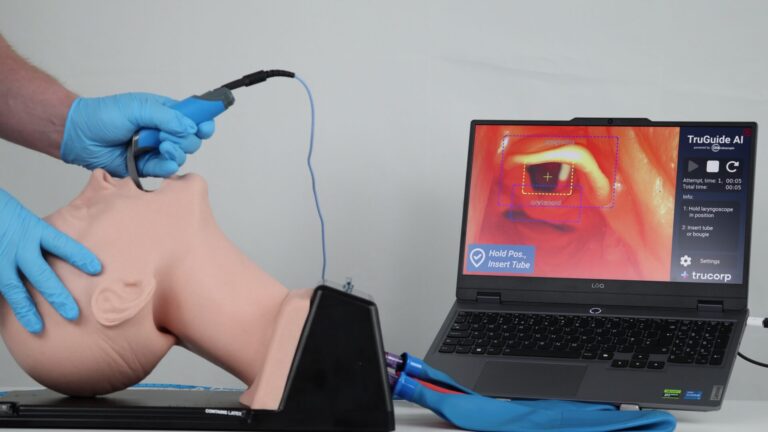
AI-enabled airway training systems typically analyse videolaryngoscopy images in real time, identifying key anatomical landmarks such as the epiglottis, arytenoids, and glottic opening. Some systems also provide navigational cues or alerts related to tube position.
In an educational context, this type of AI support aims to:
- Help learners recognise airway anatomy more reliably
- Reinforce correct technique during simulation
- Provide consistent visual feedback that complements instructor-led teaching
Importantly, AI in airway training is designed as an adjunct to established educational methods – not a substitute for faculty supervision, clinical judgement, or gold-standard confirmation techniques.
What the current evidence shows
AI-supported videolaryngoscopy in simulation
A 2025 prospective manikin study by Majumdar et al. (2025) evaluated whether an AI overlay integrated with videolaryngoscopy could improve intubation performance during training. While intubations performed with AI overlay took longer than those without AI, there was no significant difference in supervisor-assessed technique or self-reported improvement.
Crucially, 83% of participants rated the AI overlay as extremely, very, or somewhat useful, with many highlighting its value for training and for novice or less experienced clinicians. The authors concluded that AI shows promise as a supportive training tool, particularly in simulation environments, while emphasising the need for further research (Majumdar et al., 2025).
These findings align with broader educational principles: new technologies may initially slow task performance, but still add value by improving understanding, confidence, and consistency during learning.
First-in-human evidence for AI-assisted intubation
Moving beyond simulation, Fuchs et al. (2025) published the first prospective in-human study evaluating AI-assisted tracheal intubation. In this observational study of 110 elective surgical patients, AI software demonstrated a 94% sensitivity for identifying correct tracheal tube placement when compared with expert clinician judgement.
The authors were clear that AI should not replace established confirmation methods such as capnography. However, the study demonstrated the feasibility and potential safety of AI-based visual support during airway management, particularly when image quality is good.
From an educational perspective, this study is significant because it validates the underlying technology in real clinical conditions, supporting its role as a future adjunct in training and skill development rather than as an autonomous decision-maker (Fuchs et al., 2025).
What this means for educators and learners
Taken together, the published evidence suggests that AI-supported airway tools may offer particular value in:
- Simulation-based education, where learners can safely practise recognition of anatomy and technique
- Novice training, by reinforcing visual cues that experienced clinicians may apply intuitively
- Standardised feedback, supporting consistency across instructors and training sessions
Educational reviews also emphasise that effective airway training relies on deliberate practice, repetition, and timely feedback (Baker et al., 2025). AI tools, when integrated thoughtfully into simulation programmes, have the potential to enhance these principles rather than replace traditional teaching methods (Baker et al., 2025).
Looking ahead
Research into AI-supported airway education is still evolving. Current studies highlight both promise and limitations, including the need for high-quality imaging, appropriate user training, and continued evaluation across different learner groups and airway scenarios.
Ongoing and future research will help clarify how AI can be best integrated into airway education curricula, particularly for novice learners and in simulated difficult airway scenarios. As with any emerging technology, careful adoption guided by evidence remains essential.
Key takeaway
AI is not a replacement for airway educators or clinical expertise. However, published evidence increasingly supports its role as a supportive educational tool within simulation-based airway training. When used appropriately, AI has the potential to enhance learning, reinforce anatomical understanding, and contribute to safer, more consistent airway education.
This TruGuide article is based on peer-reviewed, published research and reflects the current state of evidence as of 2025.
Learn more about TruGuide
TruGuide is an AI-supported airway training solution designed to support simulation-based learning by providing real-time anatomical visualisation and feedback during videolaryngoscopy training.
It is intended to complement established airway education practices and instructor-led training, helping learners develop confidence and anatomical understanding in a safe simulation environment.
Visit the TruGuide product page to learn more
TruGuide is intended to support education and training and should be used alongside established airway teaching practices and clinical confirmation methods.
Explore the evidence