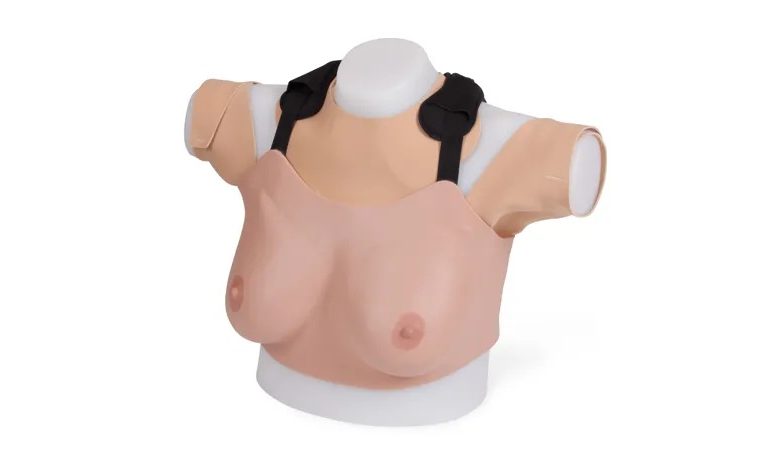
Advanced Breast Examination Trainer (Light Skin Tone)
Overview
The Advanced Breast Examination Trainer offers a hybrid training solution, covering bench top and simulated patient learning.
This model gives the widest variety of examinable anatomy and pathologies in the Breast Trainer range. The inclusion of a clavicle, and two axilla pads, allows for the placement of lymph nodes in six locations, covering axillary, supra and infraclavicular positions.
The WCRF International (World Cancer Research Fund) found that breast cancer is the most common cancer worldwide, accounting for 12.5% of the total number of cases diagnosed in 2020.*
Many health care professionals are required to conduct diagnostic breast examinations to identify pathologies in the breast tissue, as part of their routine job. When designing the latest version of our Breast Examination Trainer we made strides in improving the realism and pathologies of the model, in close collaboration with:
Peter Donnelly of Torbay Hospital, UK
Staff of the Clinical Skills Resource Centre, University of Liverpool, UK
Staff of The Clinical Practice Centre, St James’ University Hospital, Leeds, UK
Curriculum references and learning areas listed for this product. Edition dates are retained from the supplier’s references.
Postgraduate Nursing
National Organisation of Nurse Practitioner Faculties, Nurse Practitioner Core Competencies Content, 2017 Independent Practice Competencies p.14 3.b Uses advanced health assessment skills to differentiate between normal, variations of normal and abnormal findings. 3.c Employs screening and diagnostic strategies in the development of diagnoses.
Family Medicine
AAFP Recommended Curriculum Guidelines for Family Medicine Residents Reprint No. 282, 2016 Women’s Health and Gynecologic Care p.7 9. Breast health a. Anatomy and physiology of benign diseases of the breast (including cysts, adenomas, and fibrocystic changes through the menstrual cycle) b. Evaluation and management of breast disease… d. Evidence-based recommendations … clinical breast examination (CBE), breast self-examination (BSE)
Undergraduate Medicine
AAMC (2008) – Recommendations for Preclerkship Clinical Skills Education for Undergraduate Medical Education p.26 Appendix 5: Patient Examination. “Perform … breast exam and describe examination process and findings”
Postgraduate Junior Doctors
CPMEC Australian Curriculm Framework for Junior Doctors v 3.1, 2012, p.7: History and Examination: Performs a comprehensive examination of all systems; Elicits symptoms & signs relevant to the presenting problem or condition. Discriminates between the possible differential diagnoses relevant to a patient's presenting problems or conditions
Specialist GP Trainees
Curriculum for Australian General Practice 2016, CS16 Core Skills unit, p.23 CS2.2.2.2a Demonstrate appropriate and respectful physical examination technique CS2.2.2.5a Identify situations where physical examination findings are inconsistent with history CS2.2.2.2b Effectively utilise appropriate clinical tools to optimise examination CS2.2.2.3b Effectively summarise key examination findings for the patient
OB/GYNAE
RANZCOG Curriculum, 3rd Ed. (2015) p.49 B.1.2 Antenatal care Assess and manage common clinical problems that arise in pregnancy …Breast pain, breast lump
Undergraduate Medicine
Medical Deans' Clinical Assessment Blueprints for the medical graduate 4. Conducts … organ(s)/system specific physical examination as appropriate. 5. Integrates the information obtained to arrive at an appropriate diagnosis and differential diagnosis.
Physician Associate
Competence and Curriculum Framework for the Physician Assistant 2012, p 12 and 23 2.3.5 …Perform a physical examination tailored to the needs of the patient and the demands of the clinical situation, including …breast examination …The Physician Assistant should be familiar with the following patient presentations and should be able to manage and diagnose / refer appropriately: …Breast problems (lump, pain, discharge, surface changes)
CMT
Specialty Training Curriculum for Core Medical Training, 2013 p. 117: Oncology Common cancers (presentation, diagnosis, staging, treatment principles): …breast.
Postgrad FY1 FY2
The UK Foundation Programme Curriculum 2016. p.9: obtains history, performs clinical examination, formulates differential diagnosis and management plan (FPC 11)
General Surgery Training
The Intercollegiate Surgical Curriculum – General Surgery, 2016, p.32 12.5.2 Manage patients presenting with any breast condition. Competent to assess … female patients with breast symptoms or signs within the breast diagnostic MDT
Undergraduate Medicine
Outcomes for Graduates 2018, General Medical Council, p.16 Diagnosis and medical management: 14b. safely and sensitively undertake an appropriate physical examination …interpret findings from physical examinations…synthesise findings from the history, physical and mental state examinations and investigations … and make proposals about underlying causes or pathology
Postgraduate Nursing
Royal College of Nursing Clinical Standards for working in a Breast Specialty, 2007, p 11 conduct clinical examination of the breast, axilla and regional lymph nodes RCGP General Practice Foundation General Practice Nurse competencies 2012, p 38 Teach and encourage patients to be ‘breast aware'
GP Training
Guidance for Satisfactory Progression at ARCP panels for GP Specialty Trainees, 2016 p.6 … evidence of competence of intimate examinations which includes breast examination
What type of breast exams can be performed on the Limbs & Things breast trainer?
Both Breast Self Examinations (BSE) and Clinical Breast Exams (CBE) can be performed on our examination breast models.
Medical professionals can use the Advanced Breast Trainer to train in:
Breast palpation to identify lumps/masses, including size and shape
Axillary, subpectoral, supraclavicular and infraclavicular lymph node palpation
Identification of fibrocystic disease, fibroadenoma, cysts and carcinomas
Can the breast examination simulator be used to identify different pathologies, including signs of breast cancer?
Yes, the trainer comes with a variety of different pathologies. As standard, all Limbs & Things breast exam models come with representations of 2, 3 & 5cm carcinomas, a cyst, a fibroadenoma, and fibrocystic disease.
The advanced breast exam simulator also comes with lymph node pads, allowing for the identification of axillary, supra and infraclavicular lymph nodes.
What parts of the Clinical Breast Examination (CBE) can be done on the advanced breast exam simulator?
From a typical clinical examination, the breast examination simulator can be used for the following training:
Breast palpation to identify:
Tenderness
Masses – including size, shape, edge, consistency, surface, and relations
Lymph node palpation:
Axillary (anterior, posterior, medial, lateral and apical)