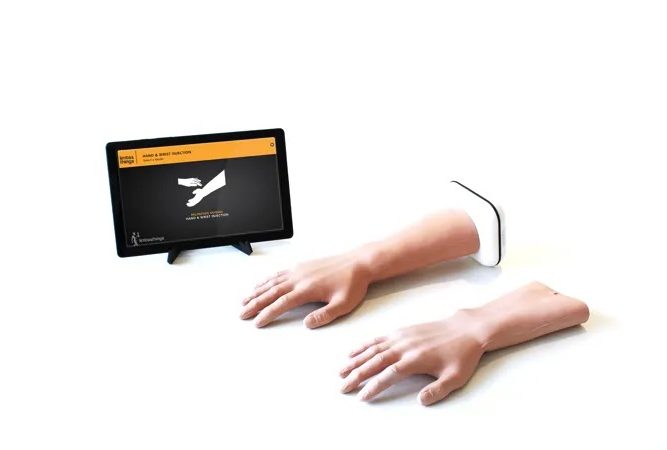
Hand & Wrist Injection Trainer (With Tablet, Light Skin Tone)
Overview
Suitable for all levels of training, the Hand & Wrist Injection Trainer allows trainees and clinicians to practice and teach injections in five different locations within the hand and wrist.
An anatomically correct representation of an adult hand and partial forearm, with important landmarks and underlying structures, the palpation guided trainer allows for injections into the:
Carpal Tunnel
De Quervain’s Sheath
Trigger Finger
First Carpometacarpal Joint
Distal Radioulnar Joint
Additionally, the presence of the Median Nerve adds another level of realism and complexity.
The trainer comes equipped with an Android tablet, which works in unison with our app. The app, coupled with innovative sensory technology, provides learners with wireless, real-time feedback from the procedure. An Interactive Anatomy element allows users to rotate the detailed model anatomy 360 degrees so each injection site can be viewed and analysed from a number of angles.
A mobile android tablet is provided which is guaranteed compatible with the hand & wrist injection trainer. The application is pre-installed on the tablet provided. If you already have a compatible tablet then a hand & wrist injection trainer can be purchased without a tablet.
Facilitates injection in five key sites of the hand and wrist
Presence of the Median Nerve allows for negative feedback
App provides interactive real-time feedback
Each site can withstand extensive repeated injections
Skin can be easily removed and changed
Interactive model anatomy
Realism
Interactive model anatomy
Anatomically accurate male adult
Includes important ligament and skeletal structures
Versatility
Lightweight and easily portable
Can be used alongside a simulated patient for communication training
App can be set to English UK, English USA, French, Mandarin, Spanish and German
Anatomy
Injection Sites
Carpal Tunnel
De Quervain’s Sheath
Trigger Finger
First Carpometacarpal Joint
Distal Radioulnar Joint
Median Nerve
Internal Product Anatomy:
Palmaris Longus
Flexor Carpi Radialis
Extensor Digitorum Group
Extensor Digiti Minimi
Abductor Pollicus Longus
Extensor Pollicus Brevis
Extensor Pollicus Longus
Trigger finger nodule (palpation guide)
Bone structures:
Radial Styloid
Ulnar Styloid
Trapezius and Scaphoid
First Carpometacarpal Joint space
Distal Radioulnar Joint space
Lister’s tubercle
Cleaning
Can be cleaned by wiping with soap and water
Safety
Fluid should not be injected into any of the sites
Take care when cleaning trainer as electronics are present
This trainer is latex free
Skills
Skills Gained
Model also includes technology that ensures trainees learn to avoid the Median Nerve
Patient positioning and management
Communication skills when used with a simulated patient
Identification of anatomical landmarks
Injecting into the:
Carpal Tunnel
De Quervain’s Sheath
Trigger Finger
1st Carpometacarpal Joint
Distal Radioulnar Joint
Curriculum
Curriculum references and learning areas listed for this product. Edition dates are retained from the supplier’s references.
Undergraduate
Recommendations for Clinical Skills Curricula for Undergraduate Medical Education, Association of American Medical Colleges, 2008, Appendix B; Clinical Testing and Procedural Skills, p.26 Perform and describe systematic examination of major joints including inspection, palpation, range of motion, and identification of important anatomical landmarks Recommendations for Clinical Skills Curricula for Undergraduate Medical Education, Association of American Medical Colleges, 2005, Appendix B; Clinical Testing and Procedural Skills, p.23 Testing & Procedure Skills: Joint Aspiration Technique; Joint Fluid Examination” Procedural skills: What’s taught in medical school, what ought to be? SR Turner, J Hanson, CJ de Gara, Non-AAMC Recommended: Joint aspiration – % of Schools That Teach – 88%
Family Medicine Residency
http://mahec.net/?/residency-and-student-info/residency-program/family-medicine-asheville/our-curriculum Diagnose and stabilize common musculoskeletal trauma and sports injuries, and inject soft tissues and joints; Gain procedural skills (shoulder and knee injections, aspirations…)
Graduate Medical Education in Pain Medicine
ACGME Program Requirements for Graduate Medical Education in Pain Medicine (Anesthesiology, Neurology, or Physical Medicine and Rehabilitation), Accreditation council for Graduate Medical Education, effective 2017, p.17 IV.A.5.b).(4).(j) joint and bursal injections, including sacroiliac, hip, knee, and shoulder joint injections;
Graduate Medical Education in Physical Medicine and Rehabilitation
ACGME Program Requirements for Graduate Medical Education in Physical Medicine and Rehabilitation, Accreditation council for Graduate Medical Education, effective 2017, p.17 IV.A.5.a).(2).(a) must demonstrate competence in the: performance of therapeutic and diagnostic injections. ACGME Case Log Entry System, Review Committee for Physical Medicine and Rehabilitation, 2014 Peripheral joint/intra-articular injection – (use for small, medium OR major joints, including hip) Peripheral nerve injection (such as suprascapular, infrapatellar,etc.) Ultrasound guidance for needle placement
Graduate Medical Education in Orthopaedic Surgery
The Orthopaedic Surgery Milestones Project, A Joint Initiative of The Accreditation Council for Graduate Medical Education and The American Board of Orthopaedic Surgery, July 2015, p.35 Performs simple shoulder procedures (e.g., subacromial injection)
Rheumatology Fellows
Core Curriculum Outline, for Rheumatology Fellowship Programs, American College of Rheumatology, 2015, p 16 and p 85 Demonstrate competence in arthrocentesis, joint and soft tissue injections. Perform procedures including arthrocentesis and joint and soft tissue injections with ultrasound guidance, when appropriate and feasible.
Graduate Medical Education in Musculoskeletal Radiology
ACGME Program Requirements for Graduate Medical Education in Musculoskeletal Radiology Accreditation council for Graduate Medical Education, effective 2017, p.2 supervised experience in the application and interpretation of all imaging examinations and procedures as they relate to the analysis of disorders of the musculoskeletal system, including bones, joints, and soft tissues. The imaging methods and procedures include …. diagnostic and therapeutic injections …
Nurse Practitioner (NP) and Physician Assistant (PA) Specialising in Rheumatology
Nurse Practitioner (NP) and Physician Assistant (PA) Rheumatology Curriculum Outline, American College of Rheumatology (ACR) and Association of Rheumatology Health Professionals (ARHP), 2017, p.8 Perform procedures, as agreed upon by the supervising/collaborating rheumatologist and NP/PA: 2. Joint and soft tissue injections (adult) a. Indications and contraindications b. Large and medium joints (i.e., knee) c. Trigger points d. Greater trochanteric bursae e. Subacromial space
Physician Assistant (PA) Specialising in Orthopaedics
PAs and OPAs, The Distinctions, American Academy of Pas, 2016, p.5 Joint Injections Physician Assistant – Yes
Undergraduate
University of Otago Clinical Skills in the Undergraduate Medical Curriculum, 2013; p.27 Joint injection/aspiration – knows how to do… by the end of the Trainee Intern year
Postgraduate
Australian Curriculum Framework for Junior Doctors, Confederation of Postgraduate Medical Education Councils, version 2.2, p.1 Doctors should be able to provide safe treatment to patients through competently performing … Joint aspiration or injection)
Rheumatology Specialist Trainees
Rheumatology Advanced Training Curriculum, Royal Australasian College of Physicians, 2013, p.8 be competent in the use of appropriate diagnostic and therapeutic procedures, including joint and soft tissue injection and aspiration
Sport and Exercise Medicine Trainees
ACSEP CURRICULUM, Australasian College of Sports and Exercise Physicians, 2017 Demonstrate proficient and appropriate use of procedural skills, both diagnostic and therapeutic. Assessment: Direct Observation of Procedural Skills (DOPS): • Subacromial joint space injection • Acromioclavicular joint injection
Radiology Specialist Trainees
2014 RANZCR. Radiodiagnosis Training Program – Curriculum Version 2.1 Musculoskeletal Imaging – Clinical Conditions Category 3 (= useful to know): Arthrography and joint aspiration
Specialty Training Curriculum for Core Medical Training, Joint Royal Colleges of Physicians Training Board, August 2009, p 92-93 The trainee will be able to assess a patient presenting with joint pain or swelling to produce a valid differential diagnosis, investigate appropriately, formulate and implement a management plan. Knowledge: Recall the generic anatomy of the different types of joint Differentiate between mono-, oligo-, and polyarthritis and recall principal causes for each Recall treatment options for acute arthritides e.g. analgesia, NSAIDs, steroids, physiotherapy etc Skills: Perform a competent physical examination of the musculo-skeletal system Elicit and interpret extra-articular signs of joint disease Order, interpret and act on initial investigations appropriately: blood tests, radiographs, joint aspiration, cultures Make basic interpretation of plain radiographs of swollen joints Practise safe prescribing of analgesics and NSAIDs for joint disease Arranges timely joint aspiration when appropriate to rule out septic cause
Specialist Rheumatology Trainees
Specialty Training Curriculum for Rheumatology, Joint Royal Colleges of Physicians Training Board, 2010, p.17 and 24 Regional Musculoskeletal Examination – Identifying and Interpreting Abnormalities Shoulder Pathology: The trainee should be able to identify: • Rotator cuff lesions • Glenohumeral/capsular pathology • Muscle wasting, proximal myopathy (deltoid) • S/C joint pathology – synovitis • A/C joint pathology – synovitis • Shoulder pain due to pain referred from viscera or neck 5. Practical Procedures: To be able to: Identify, in a given patient, the need for: • Joint aspiration and/or injection with corticosteroid and/or local anaesthetic • Soft tissue injection with corticosteroid and/or local anaesthetic • Aspirate and inject joints competently using the appropriate techniques • Recognise the macroscopic appearance of normal and abnormal synovial fluid (non-inflammatory, inflammatory, haemorrhagic and septic) • Identify synovial fluid crystals on polarised microscopy Competency is required in all of the following core procedures: Shoulder: Joint: Glenohumeral joint, ACJ. Soft tissue: Sub-acromial bursa. The following procedures are optional: Suprascapular nerve block The following procedures are optional: • Ultra-sound guided injections
Specialist Trauma & Orthopaedics Trainees
Specialist Training in Trauma and Orthopaedics Curriculum, British Orthopaedic Association, 2015 (Updated 2018), p.43 SHOULDER Diagnostic and guided injections Trauma & Orthopaedic Curriculum Mapped to Simulation Options, British Orthopaedic Association, 2013, p.62
Specialist Sport & Exercise Medicine Trainees
Specialty Training Curriculum for Sport and Exercise Medicine, Joint Royal Colleges of Physicians Training Board, August 2010, p.53 Skills (mandatory): Safely inject major joints including shoulder, elbow, knee and ankle
GP Training
The RCGP Curriculum: Professional & Clinical Modules, The Royal College of General Practitioners, 2016, p.327 You may also consider attending courses offering joint injection training.
Clinical Radiology Trainees
Speciality Training Curriculum for Clinical Radiology, 2016, p.111 Level 1 Musculoskeletal Training includes Therapeutic joint and soft tissue injections,
Can I use this hand & wrist injection simulator for self-directed learning? Yes, the hand & wrist simulator has an accompanying app which allows trainees to receive instant positive & negative feedback from the model depending on whether the correct injection site is hit.
What is the expected battery life for the Hand & Wrist Injection Trainer? Operated by 2 x AA batteries, the trainer has undergone laboratory testing, and we’ve shown that the batteries can last for over 500 hours of injection practice.
What are the requirements to use the app on my own device? The trainer works over Bluetooth, so a Bluetooth enabled Android™ tablet or phone is required for training. This allows the needles and device to be completely wireless, ensuring maximum realism when injecting sites
Can I practise different injection techniques on this model? The Hand & Wrist trainer is anatomically accurate, meaning a wide range of techniques and approaches can be taken with the model to ensure trainees can hit a gold standard of training.
Specifications
Weight & Dimensions
Weight: 3 kg
Width: 26 cm
Height: 18 cm
Length: 52 cm
Dimensions and weights are reproduced in the form provided by the supplier. Entries labelled “Box” refer to packaging.