Knot Tying Trainer

Share this article:

Product overview · 50050

Knot Tying Trainer

Limbs & Things logo

Knot Tying Trainer — product photograph

Overview

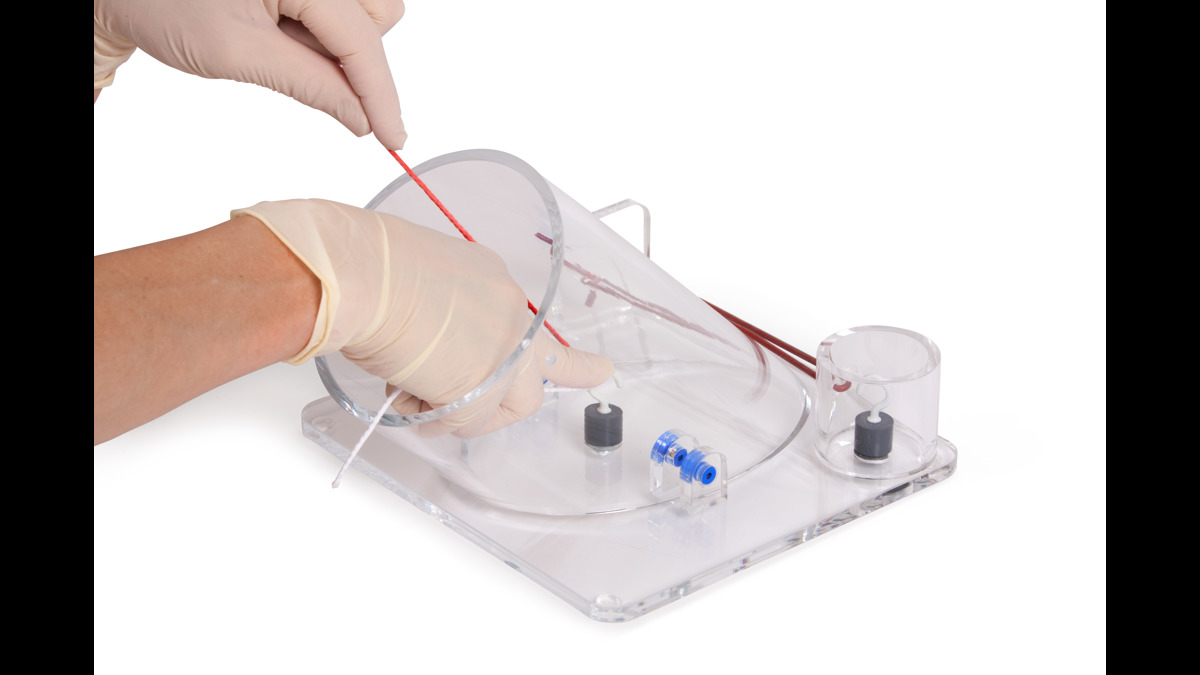
Designed with UK surgical consultants, this compact trainer covers all core knot-tying techniques required for the Intercollegiate Basic Surgical Skills Course. It offers realistic feedback with a magnetic tension system and elastic knotting tubes that simulate tissue resistance.

The compact trainer features interchangeable modules to allow tying in small spaces, at depth and at angles.

Features

Highlights
  • Comprehensive surgical knot-tying trainer.
  • Developed in collaboration with Mr. Jonathan Beard (Northern General Hospital, Sheffield) and Mr. John Rochester (Rotherham General Hospital, UK).
  • Used in the GB and Ireland Intercollegiate Basic Surgical Skills Course.
  • Compact and lightweight — ideal for classroom or on-the-go training
  • Cylinders are transparent to allow the trainer to observe and assess trainee competence
Realism
  • Unique magnetic tension system simulates tissue resistance
  • Elastic knotting tubes mimic the feel of live tissue
Versatility
  • Interchangeable scenarios – choose between small, fixed cylinder for narrow spaces or large, deep cylinder for deep or angled tying
  • Supports training in varied orientations and anatomical scenarios.
Anatomy

2 perioperative openings represented by:

  • A small fixed cylinder to represent confined anatomical spaces (e.g. vessels, small cavities)
  • A large, deep cylinder, reversible to mimic abdominal and gynaecological access
Cleaning
  • Removable cylinders and knotting tubes for easy cleaning and maintenance.
Safety
  • Latex free

Skills

Skills Gained

  • One-handed reef knot
  • Instrument tie
  • Surgeon’s knot
  • Slip knot
  • Tying in a small opening
  • Deep vertical tying in a large cavity
  • Angled depth tying for abdominal/gynaecological procedures

Curriculum

Curriculum references and learning areas listed for this product. Edition dates are retained from the supplier’s references.

Family Medicine

AAFP Recommended Curriculum Guidelines for Family Medicine Residents, Urgent and Emergent Care, Reprint No. 285, 2016, p.9 6. Other Skills a. Repair of skin lacerations (including plastic closure)

Surgery

ACGME General Surgery Milestones (p.8): This resident has basic surgical skills such as … knot tying

Undergraduate Medicine

AAMC, Recommendations For Clinical Skills Curricula For Undergraduate Medical Education (2005, p. 30) Appendix B: Clinical Testing and Procedural Skills: …Surgical knot-tying

Postgraduate Nursing

Adult-Gerontology Acute Care And Primary Care NP Competencies 2016, p.42 Primary care practice skills which includes, but is not limited to: • Suturing

Obstetric Training

ACGME Obstetrics and Gynecology Milestones, Version 09/2013, Patient Care, p.6 Demonstrates basic surgical skills, including: knot tying simple suturing

Postgraduate Junior Doctors

CPMEC Australian Curriculum Framework for Junior Doctors version 3.1, 2012, p.31 Skills & Procedures: Surgical knots

Specialist GP Trainees

RACGP Curriculum for Australian General Practice 2016, CS2.2.5 Appropriate procedures, p.39 • suturing

Undergraduate Medicine

Health Workforce Australia Medical Graduate Competency Framework Stage 2 Final Report, 2012 Simple wound repair including skin suture – Performs in a simulated environment

General Surgery Training

The Intercollegiate Surgical Curriculum, General Surgery 2013 (Updated 2018) (pp.44-45) Module 3 Basic surgical skills… o To tie secure knots

Product Downloads

User Guide Knot Tying Trainer PDF | 519.8 KB ↗

Specifications

Weight & Dimensions
  • Weight: 1.15 kg
  • Width: 24 cm
  • Height: 16 cm
  • Length: 31 cm

Dimensions and weights are reproduced in the form provided by the supplier. Entries labelled “Box” refer to packaging.

Discuss your training requirements

Contact Survival Technology about this product, its configuration and your teaching requirements.

Contact Survival Technology

Quote Cart
Scroll to Top